A goatee is one of the most face-defining styles a man can wear — and one of the least forgiving when the hair simply won’t grow the way you want it to. A patchy chin, a mustache that never quite connects, or a goatee that grows unevenly on one side isn’t something you can fix by waiting longer. A goatee beard transplant is a permanent, surgical way to build the specific shape you’re after, using your own hair.
This page is written specifically about the goatee — not a general overview of beard transplantation with “goatee” inserted a few times. If you’re trying to understand how a goatee transplant actually works, how many grafts it realistically takes, what it costs in Turkey in 2026, and how to judge before/after results properly, this covers it.
What Is a Goatee Beard Transplant?
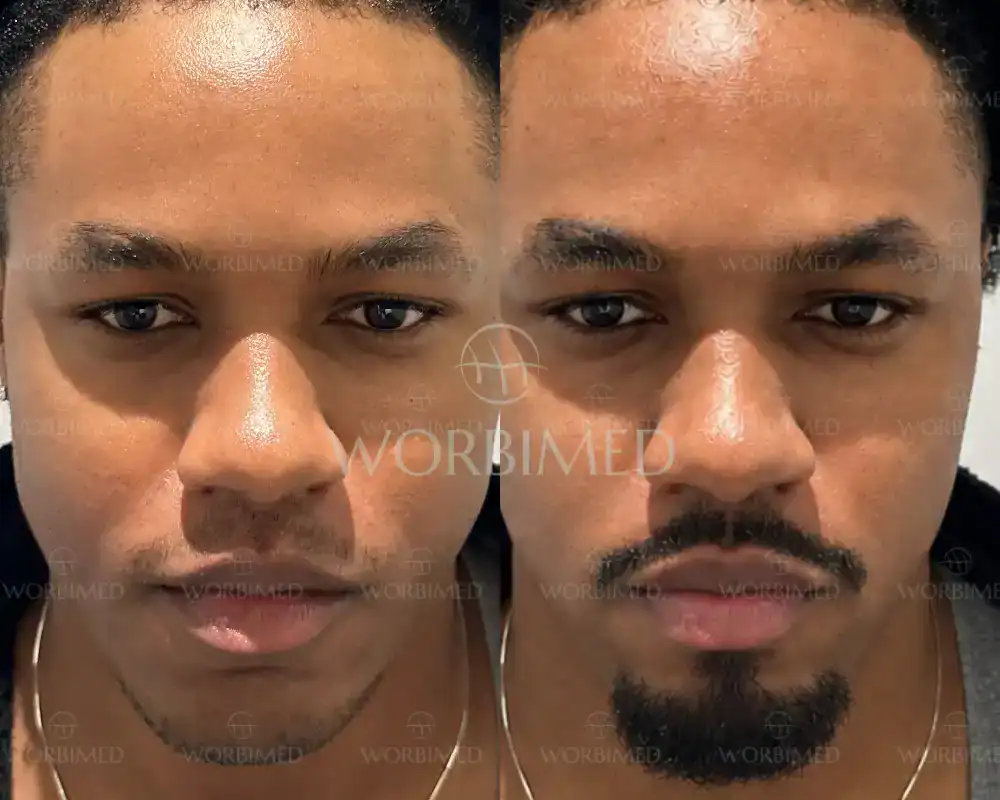
A goatee beard transplant is a hair restoration procedure that adds hair follicles specifically to the chin, the area directly around the mouth and chin (“soul patch”), and the connection between the mustache and chin — the zone that together makes up a goatee.
Donor hair is removed one follicle at a time (a technique called FUE — Follicular Unit Extraction), usually from the back or sides of the scalp, and sometimes from beard hair on the cheeks or under the jaw if it’s denser or a better texture match. Each follicle is then implanted into the chin/goatee area at a carefully chosen angle and direction, so the new hair grows the way facial hair naturally grows in that specific spot — not the way scalp hair grows.
Because a goatee sits in a small, highly visible area right in the center of the face, the margin for error is smaller than it is on a full beard or a scalp hairline. A few degrees of incorrect angle, or a slightly off outline, is much more noticeable on a goatee than it would be spread across a full jawline.
Contents
Why Someone Might Need a Goatee Transplant
There’s no single “typical” goatee patient. Reasons people look into this procedure include:
- Naturally sparse or patchy chin hair — some men simply never grow dense hair on the chin, regardless of age or testosterone levels
- A weak or broken mustache-to-chin connection — hair on the chin and hair above the lip, but a visible gap between them
- Asymmetrical growth — a goatee that fills in fully on one side of the chin but not the other
- Scarring — from acne, injury, or previous surgery, which can prevent hair from growing normally in that spot
- Previous procedures that didn’t achieve the intended shape or density
- A general hair-loss pattern that also affects facial hair, not just the scalp
- Wanting a stronger, more deliberate goatee shape than what grows in naturally, even without any “medical” gap
The right approach — and the number of grafts required — depends heavily on which of these applies, which is why a proper consultation (not a generic quote) matters more here than almost anywhere else on the face.
Can You Get a Goatee If You Have Little or No Chin Hair?
Yes, in many cases — a beard transplant can create facial hair in an area with very little or no existing growth, provided you have enough usable donor hair and your skin is a suitable candidate for grafting.
That said, this isn’t guaranteed for everyone, and no honest clinic should promise a specific final look before an in-person or video consultation. Limiting factors include:
- How much donor hair is actually available on your scalp and body
- The condition of the skin in the goatee area (healthy vs. scarred vs. previously operated on)
- How dense a result you’re aiming for — a subtle, natural fill is more achievable than an extremely thick, uniform block of hair in one session
- The natural characteristics of your donor hair (thickness, curl, color) compared with what a goatee typically needs
- Realistic expectations about how the result will look once it’s fully matured, not right after surgery
How Is a Goatee Designed?
This is the part that separates a natural-looking goatee from an obviously “transplanted” one, and it’s the part most competitor pages skip entirely.
A goatee isn’t one universal shape. Design decisions are based on:
- Chin shape and width — a narrow chin needs a different outline than a wide, square chin
- Jawline — where the goatee should (and shouldn’t) blend into the jaw
- Existing mustache — its density, shape, and whether it needs to be extended to connect with the chin
- Facial proportions — how the goatee sits relative to the whole face, not just the chin in isolation
- Patient preference — a classic small circle beard, a wider goatee, an anchor-style shape, or something closer to a full chin beard
- Donor availability — the size and density of the design has to be realistic against what your donor area can actually supply
- Natural hair growth direction — hair on the chin, under the lower lip, and around the mouth grows in different directions and at different angles, and a well-designed goatee follows that pattern rather than fighting it
A goatee has several specific zones that a surgeon designs around:
- Chin pad — the central, raised area of the chin
- Chin point — the lowest tip of the chin
- Soul patch — the small patch of hair directly under the lower lip
- Mustache connection — the strip linking the mustache to the chin hair, if the design calls for one
- Transition zones — the soft edges where goatee hair blends into clean-shaven skin, rather than stopping in a hard, artificial line
A perfectly straight, symmetrical, hard-edged outline is usually a sign of a less natural result, not a more precise one — real facial hair grows with small irregularities, and a good design deliberately keeps some of that.
Goatee Beard Transplant Cost in Turkey (2026)
Goatee beard transplant cost in Turkey typically ranges from $1,800 to $2,700 for a goatee-only or goatee+moustache package. This sits within the wider facial-hair pricing band Turkish clinics quote — roughly $1,500–$4,500 across mustache, partial, and full-beard procedures — and depends mainly on graft count, technique, and what’s bundled into the package.
There’s no single flat “Turkey price” that applies to every patient — any page quoting one number for everyone is oversimplifying — but the range above reflects pricing publicly advertised across multiple Turkish clinics, not one clinic’s number presented as the market rate.
| Procedure | Approximate graft range* | Typical Turkey cost range* |
|---|---|---|
| Moustache only | 300–600 | ~$1,500–$2,000 |
| Goatee only | 600–1,500 | ~$1,800–$2,700 |
| Partial beard (goatee + cheeks/patches) | 1,000–2,500 | ~$2,000–$3,200 |
| Full beard | 2,500–4,500+ | ~$2,700–$4,800 |
*Ranges compiled from multiple independent clinic and industry sources, presented as estimates only — not a Worbimed quote.
Why the price varies this much even within “goatee transplant”:
- Number of grafts your specific design requires
- Whether it’s goatee-only or combined with a mustache connection
- Technique used (FUE vs. DHI — DHI is often priced somewhat higher)
- The clinic’s facility type and reputation
- Number of sessions needed
- What’s bundled into the package (see below)
- Whether PRP or other add-on treatments are included
What Does the Price Actually Include?
A low advertised starting price is not the same as the full cost of your treatment. Before comparing prices between clinics, check whether the quote includes:
- Initial consultation
- Pre-operative blood tests
- The surgery itself (surgeon and clinic fees)
- Local anesthesia and medication
- Hotel accommodation
- Airport transfers
- Post-operative washing sessions
- PRP, if included
- Follow-up consultations after you return home
- Interpreter support, if relevant to your language
Two clinics quoting different headline prices may end up costing about the same once you account for what’s actually bundled — and the cheapest advertised number is sometimes the one with the fewest inclusions.
Goatee Transplant vs. Full Beard vs. Partial Beard Transplant
These are related procedures, but they’re not interchangeable, and the right one depends entirely on what you’re missing.
| Goatee transplant | Partial beard transplant | Full beard transplant | |
|---|---|---|---|
| Treatment area | Chin, soul patch, mustache-chin connection | Goatee plus cheeks or sideburns, or scattered patches | Cheeks, jawline, chin, mustache, sideburns — the entire beard area |
| Typical graft range* | ~600–1,500 | ~1,000–2,500 | ~2,500–4,500+ |
| Design complexity | High precision in a small, highly visible zone | Moderate — matching new hair to existing growth | High — coordinating multiple zones into one cohesive shape |
| Typical cost position | Lower end of facial-hair pricing | Mid-range | Higher end |
| Recovery | Same for all three — local anesthesia, short recovery | Same | Same |
*Estimates only, drawn from multiple independent clinical and clinic sources — not a quote. Your actual graft count depends on your existing hair, donor supply, and design goals.
No single option is “better” — a goatee-only transplant is the right choice for someone whose cheeks and jawline already grow well but whose chin doesn’t, while a full beard transplant suits someone with widespread thinning across the whole face.
Goatee Transplant vs. Moustache Transplant
A moustache and a goatee are often planned together, but they’re aesthetically and technically distinct:
- Different hair angle: upper-lip hair grows at a different angle and direction than chin hair
- Different aesthetic role: the mustache frames the mouth from above, while the goatee frames the chin and jaw from below; how well they connect (or deliberately don’t) defines the overall look
- Can be treated in the same session: if you need both a mustache and a goatee — or specifically the connection between them — this is usually planned and executed as one combined procedure rather than two separate ones, since the donor extraction and design process overlap
How Many Grafts Are Needed for a Goatee?
There’s no single correct number — graft count depends on the size of the area, how much hair you already have, your density goal, and your donor supply. Based on ranges reported across multiple independent hair-restoration sources, rough estimates look like this:
| Scenario | Approximate graft range | Notes |
|---|---|---|
| Small patch repair (uneven density, small gaps) | ~300–700 | Filling isolated thin spots, not building a new goatee from scratch |
| Moderate goatee restoration (existing but patchy hair) | ~600–1,200 | The most common goatee-only scenario |
| New goatee creation (little to no existing chin hair) | ~800–1,500 | Requires more donor hair and a fuller design |
| Goatee + mustache connection combined | ~1,000–1,500+ | Treats both zones as one connected design |
These are examples, not guaranteed treatment plans. Your own graft count can only be determined properly during a consultation that looks at your actual donor density, existing facial hair, and desired shape.
It’s also worth understanding that more grafts doesn’t automatically mean a better result. A goatee is a small, dense zone — precise placement, correct angling, and matching donor-hair characteristics matter more to the final look than raw graft count. A smaller, well-executed goatee restoration can look far more natural than an over-dense one placed without attention to direction and transition zones.
FUE vs. DHI for a Goatee Transplant
Both techniques are used for facial hair, and neither is universally “better” — the right choice depends on your case and, more importantly, on the surgeon’s skill with that technique.
FUE (Follicular Unit Extraction): individual follicles are extracted one at a time, recipient sites are created, and grafts are implanted. It’s the more widely used technique for facial hair and tends to allow slightly faster extraction across a larger area.
DHI (Direct Hair Implantation): follicles are extracted and then implanted directly using a specialized pen-style tool, without a separate recipient-site-creation step. This can allow for very fine control over implantation angle and depth — which matters in a small, high-precision zone like a goatee.
What actually determines your result is less about which label is used and more about:
- How carefully the extraction is done (graft survival starts here)
- How accurately hair-angle and direction are planned before a single graft is placed
- How precisely recipient sites are created (FUE) or grafts are implanted (DHI)
- How the grafts are handled and stored between extraction and implantation
- The surgeon’s specific experience with facial hair, as opposed to scalp hair
A skilled team using either technique will outperform an inexperienced team using the “better” one on paper.
Why Facial Hair Angle Matters So Much
This is one of the most overlooked details in goatee transplants, and it’s the single biggest reason two goatee transplants with the same graft count can look completely different.
Facial hair doesn’t grow straight out of the skin — it emerges at specific angles and directions that vary across the chin, the soul patch, and the mustache-chin connection. A surgeon planning a goatee needs to account for:
- The angle each hair emerges at
- The direction it points
- How deep the follicle sits
- Natural curvature in that specific area
- The density and pattern of your existing hair, so new grafts blend rather than stand out
Get this wrong, and even a technically successful transplant (grafts survive, hair grows) can look artificial — hair pointing the wrong way, or growing at an angle that doesn’t match the surrounding natural hair. Get it right, and the new hair is genuinely indistinguishable from hair that grew there naturally.
Donor Hair for a Goatee Transplant
Donor hair for a goatee usually comes from one of two places:
- Scalp hair (typically the back or sides of the head) — the most common donor source, widely available in most patients
- Beard hair from elsewhere on the face — sometimes used if it’s a closer texture match, particularly for patients with dense cheek or jaw hair
Does Scalp Hair Look Natural in a Goatee?
Scalp hair and facial hair are genuinely different — in thickness, texture, curl pattern, and growth cycle. When scalp hair is transplanted into a goatee, it generally adapts over time to behave more like facial hair, but it isn’t always a perfect match to your existing beard hair from day one. Donor-hair selection — choosing the section of scalp (or beard) hair that most closely matches your existing facial hair in thickness and texture — is one of the details that separates a well-executed goatee transplant from a mediocre one. No clinic can honestly promise a 100% identical match in every case; it’s a matter of getting as close as possible and trimming/styling to blend the two once growth is established.
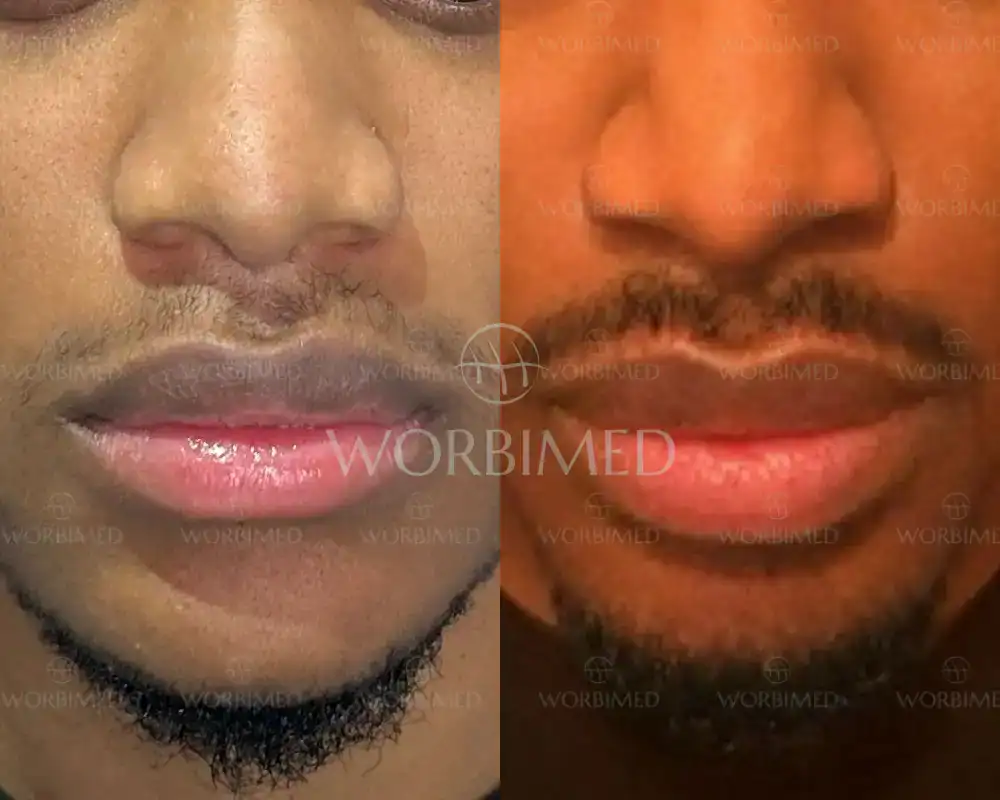
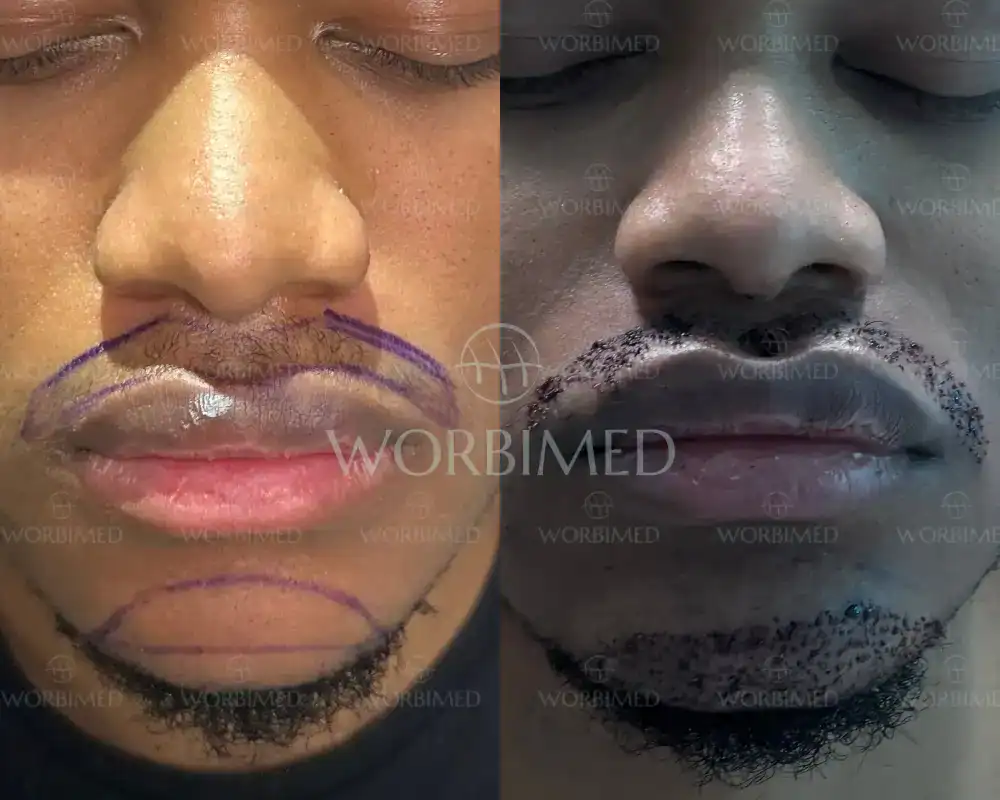
Goatee Transplant Before and After: What to Actually Look For
Before/after photos are one of the most searched — and most misused — parts of this topic. When evaluating goatee results (yours or a clinic’s example cases), look at:
- Shape and outline — does the goatee match the intended design, with soft transition zones rather than hard artificial edges?
- Symmetry — does it look balanced from both sides of the face?
- Density — is it dense enough to look intentional, without looking implanted?
- Hair direction — does new hair grow in the same direction as the surrounding natural hair?
- Mustache connection — if a connection was part of the plan, does it look continuous rather than patchy?
- Chin coverage — does the design suit the chin shape, rather than looking like a generic template applied regardless of face shape?
- Donor area — has it healed cleanly, without visible scarring or thinning?
- Maturation — early post-operative photos (weeks, not months) don’t represent the final result. A goatee needs several months to mature and settle into its final density and texture.
Photos taken immediately after surgery, before shedding and regrowth have happened, will always look sparser and redder than the eventual outcome — this is normal, not a sign of a failed procedure.
How Long Does a Goatee Transplant Take to Grow?
| Timeframe | What typically happens |
|---|---|
| First few days | Redness, mild swelling, small scabs around each graft |
| First week | Scabs begin to flake off; the area starts looking more settled |
| Weeks 2–4 | Many transplanted hairs shed — this is normal and expected, not a sign of failure |
| Months 1–2 | The shed period continues; the area may look thinner than immediately after surgery |
| Months 3–4 | New growth typically begins to appear |
| Months 5–6 | Density starts becoming visible; hair is often still fine or patchy in texture |
| Months 7–9 | Growth continues to fill in and thicken |
| Months 10–12 | Results are commonly close to their final density and texture |
Individual timelines vary. The “shedding” phase in particular catches a lot of first-time patients off guard — it’s a normal part of the growth cycle, not a sign that the transplant failed.
Recovery After a Goatee Transplant
- Swelling and redness are common for the first several days
- Scabbing around each graft site typically resolves within a week to ten days
- Sensitivity in the treated area is normal early on
- Washing follows a specific schedule your clinic will provide — don’t improvise this
- Sleeping position may need slight adjustment to avoid pressure on the treated area early on
- Exercise is usually paused for a short period to avoid excess sweating and swelling
- Sun exposure should generally be limited on the treated area while it heals
- Returning to normal appearance in public typically takes one to two weeks, though this varies by individual
Always follow your specific clinic’s aftercare instructions over any general guide — they know your case, your technique, and your healing pattern.
When Can You Shave After a Goatee Transplant?
This is a very commonly searched question, and the honest answer is: it depends on your clinic’s specific protocol, which is why it should always take priority over generic advice. In general, early shaving needs to be handled carefully to avoid disturbing newly placed grafts before they’ve properly settled — trimming and shaving become normal again once your clinic confirms the area has healed enough. Don’t shave, trim, or otherwise touch the treated area until your clinic has explicitly told you it’s safe to do so.
Risks and Possible Complications
A goatee transplant is a surgical procedure, and like any surgical procedure, it carries some risk. These are not meant to alarm you, but to give you a realistic picture:
- Infection
- Bleeding
- Swelling
- Temporary numbness in the treated area
- Discomfort or pain in the days after surgery
- Folliculitis (inflammation around hair follicles)
- Poor or uneven graft growth
- Hair growing at an unnatural angle, if planning or placement wasn’t precise
- A design that doesn’t suit the patient’s face, if planning was rushed
- Visible scarring in the donor area
- Donor-area depletion, particularly relevant if you may want further facial or scalp procedures later
- The possibility of needing revision work
Because a goatee sits in one of the most visible parts of the face, precision matters more here than in less visible areas — which is exactly why the surgeon’s specific experience with facial hair (not just scalp hair) is worth asking about directly.
Who Is a Good Candidate for a Goatee Transplant?
Good-candidate factors include:
- Sufficient donor hair supply (scalp and/or beard)
- A clear, identifiable reason for the current gap or thinness (genetic, scarring, uneven growth, etc.)
- Generally healthy skin in the treatment area
- Realistic expectations about density, timeline, and final appearance
- Absence of certain medical conditions that could affect healing (to be reviewed during consultation)
This isn’t a self-diagnosis list — it’s a starting point for the questions a proper consultation will actually answer. No article can tell you whether you’re a candidate; only an assessment of your own donor supply, skin, and goals can.
Goatee Transplant for Patchy Growth
Not everyone needs a brand-new goatee built from scratch. Many patients only need:
- A handful of specific gaps filled
- More density in the chin area specifically
- A better mustache-to-chin connection
- Improved symmetry between the two sides of the chin
- Correction of a few isolated patches, rather than a full redesign
This kind of targeted repair often requires fewer grafts than building an entire goatee from little or no hair — worth discussing directly in a consultation rather than assuming you need the largest possible package.
Goatee Transplant Over Scars
If a scar affects part of your goatee area, it deserves individual assessment rather than a standard quote. Scar tissue behaves differently from normal skin:
- Blood supply to scar tissue can be reduced compared with healthy skin
- Graft survival in scarred tissue can be less predictable than in unaffected areas
- Results vary based on the scar’s age, depth, and cause
No clinic can honestly guarantee that transplanted hair will grow in a scar exactly as it would in undamaged skin — this needs an in-person or detailed photo assessment before any commitment.
Turkey vs. UK/USA for a Goatee Transplant
| Turkey | UK / USA | |
|---|---|---|
| Typical cost | Generally the most affordable of the three, largely due to lower facility and labor costs | Typically several times higher for a comparable procedure |
| Travel | Requires international travel and a short stay | No travel required for local patients |
| Clinic availability | Very high — hundreds of clinics with facial-hair experience | Fewer dedicated facial-hair-transplant specialists |
| Package structure | Often bundled (procedure, hotel, transfers) | Usually procedure-only pricing |
| Follow-up | Requires a plan for remote follow-up once you’re home | Easier in-person follow-up |
| Regulation | Varies by clinic — verify credentials directly | Generally more standardized, but still varies by provider |
Turkey isn’t automatically the “better” option for everyone — it’s the right option for patients who’ve verified a specific clinic’s credentials, surgeon experience, and aftercare plan, and who are comfortable managing follow-up remotely after returning home. What matters most is the individual clinic and surgeon, not the country label alone.
How to Choose a Goatee Transplant Clinic in Turkey
Before booking, it’s worth asking any clinic directly:
- Who is the surgeon, specifically — not just “our team”?
- Who performs the extraction — the surgeon, or a technician?
- Who creates the recipient sites and who does the implantation?
- How many goatee or facial-hair cases has this surgeon personally performed?
- Can they show real goatee-specific before/after results — not general beard or scalp cases?
- Are those before/after photos genuinely from their own patients, taken under comparable lighting and conditions?
- What happens if growth density is disappointing — is there a revision policy?
- What exactly is included in the quoted price?
- What aftercare is provided, and for how long?
- Who handles follow-up and any complications once you’re back home?
- What are the surgeon’s actual qualifications and how are they verified?
- Is the facility properly licensed?
A clinic that answers these clearly and specifically — rather than with generic reassurance — is a stronger sign of quality than any single price point.
Why Patients Choose Worbimed for a Goatee Beard Transplant
We won’t claim to be “the best” or “number one” clinic in Turkey — that’s not something we could back up, and it wouldn’t tell you much anyway.
What we can say specifically: Worbimed treats the goatee as its own design problem, not an add-on to a general beard package. Our lead doctor has over ten years of experience with facial hair, where angle errors show far more than on the scalp — which is why the doctor personally handles extraction and channel opening, the two steps where that precision matters most, while trained technicians handle implantation under the doctor’s direction.
Want a goatee beard transplant? Get a free consultation — send us your photos and we’ll give you an honest assessment, including telling you if you’re not a good candidate yet.
What Most Clinic Pages Don’t Tell You
A few things worth knowing that rarely show up in typical marketing copy:
- More grafts doesn’t automatically produce a better goatee — precision and design matter more in this specific, small area
- Goatee design matters as much as density; a well-designed lower-density goatee often looks more natural than a poorly-designed high-density one
- Hair-angle accuracy is one of the biggest — and least discussed — factors in a natural-looking result
- Donor-hair selection (matching texture and thickness to your existing facial hair) is a real variable, not a formality
- The cheapest advertised package is not necessarily the cheapest total cost once inclusions are compared
- Small, targeted repairs can require meaningfully fewer grafts than a full goatee reconstruction
- Your existing beard density changes your graft requirement more than any generic “average” number can capture
- Early before/after photos (taken within weeks of surgery) can be misleading — real results take months to mature
- A surgeon’s specific experience with facial hair — not scalp hair generally — is a distinct skill worth asking about directly
- Revision work on facial hair, if ever needed, tends to be more delicate than the original procedure due to limited remaining donor supply in a small area
Frequently Asked Questions
Can you get a goatee transplant if you have no chin hair at all?
In many cases, yes — provided you have enough usable donor hair and healthy skin in the area. It’s not guaranteed for everyone and depends on an individual assessment.
How many grafts does a goatee transplant need?
Estimates for a goatee-only procedure commonly range from around 600 to 1,500 grafts, depending on your existing hair, the size of the design, and your density goal. This is an estimate, not a fixed number.
Is FUE or DHI better for a goatee?
Neither is universally better — outcomes depend more on the surgeon’s precision with hair-angle planning and graft placement than on which technique label is used.
How much does a goatee beard transplant cost in Turkey?
Advertised goatee-focused packages in Turkey commonly fall in a rough range of $1,800–$2,700, though this varies by graft count, technique, and what’s included in the package.
How long until a goatee transplant looks finished?
Most patients see results close to their final density and texture around 10–12 months after surgery, following a normal shedding phase in the first couple of months.
Can scalp hair look natural in a goatee?
It generally adapts over time, but it isn’t always an exact match to existing facial-hair texture from the start. Careful donor-hair selection improves the match.
Do I need a full beard transplant, or just a goatee transplant?
That depends on which areas of your facial hair actually need work. If your cheeks and jawline already grow well and only your chin/goatee area is thin or patchy, a goatee-only procedure is usually the right — and smaller — option.