If you’re researching an Afro hair transplant in Turkey, you’ve probably noticed two things quickly. Almost every clinic claims to be a specialist in Afro hair, and almost none of them explain, in real detail, what actually makes the procedure different.
This page tries to do that properly — the anatomy, the honest cost picture, the technique question, the risks (including keloids, which most clinic pages barely mention), and a way to judge whether a clinic actually knows what it’s doing.
We’ve written this as the guide we’d want a friend or family member to read before booking anything.
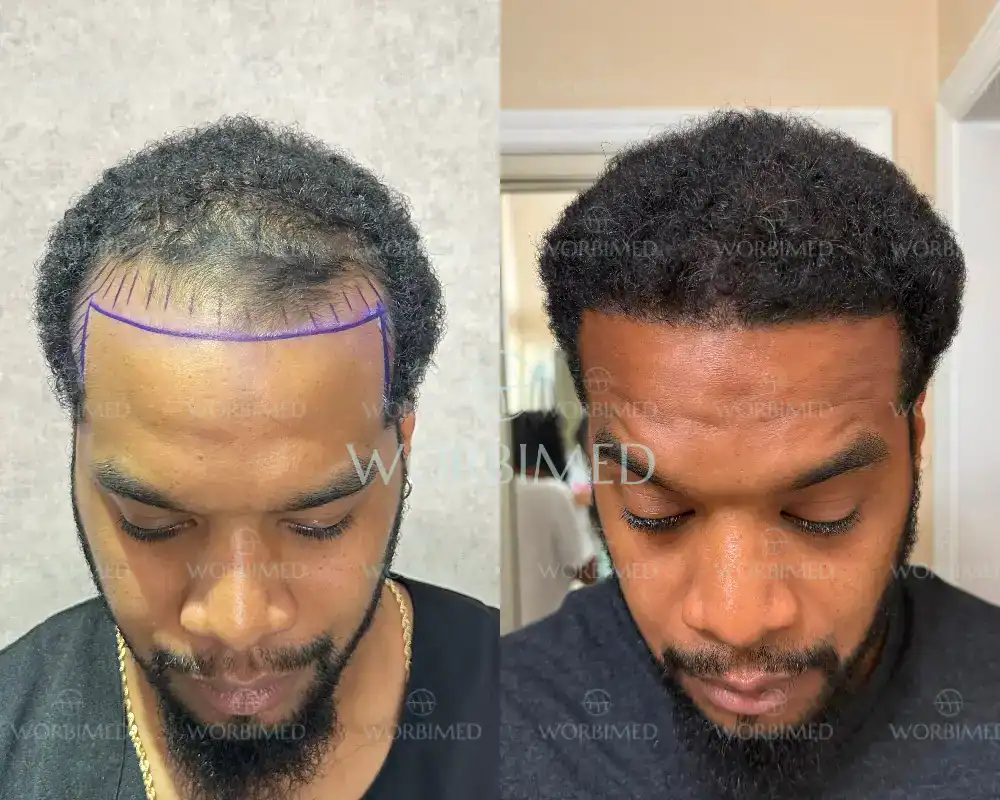
Is afro-textured hair suitable for a hair transplant?
Yes. Afro-textured hair can be transplanted successfully, but it requires a different, more careful extraction and implantation approach than straight or wavy hair — because the curl doesn’t stop at the skin’s surface.
With a surgeon and team experienced specifically in Afro hair, results are achievable and can look completely natural. The technical difficulty is real, but it’s a difficulty that’s been extensively studied and addressed with purpose-built tools and technique, not a reason to avoid the procedure.
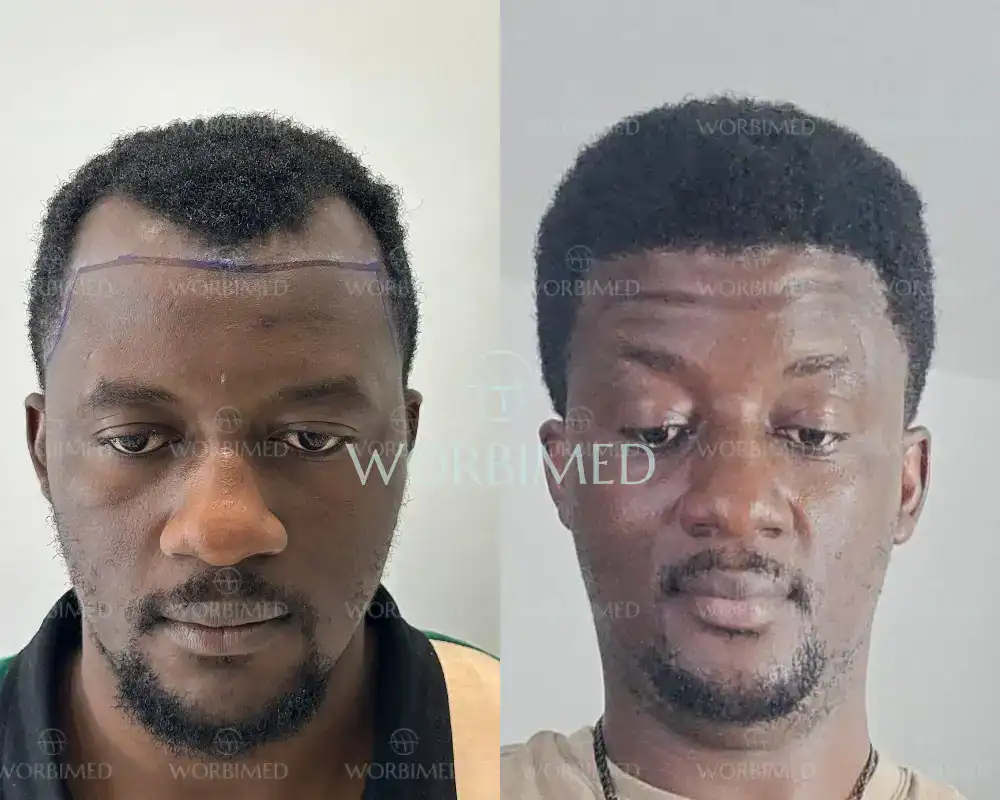
How Afro hair is different — and why it matters for surgery
Follicle curvature beneath the scalp
The curl you see on the surface of Afro-textured hair continues below the skin. Individual follicles often follow a curved or spiral path beneath the scalp rather than sitting in a straight vertical line.
Hair typing systems (3C through 4C) describe increasing curl tightness at the surface. While the correlation isn’t perfectly linear for every person, tighter curl patterns are generally associated with more pronounced subsurface curvature.
This matters because a straight extraction punch, designed with a straight follicle in mind, can easily clip a curved follicle partway down instead of following its path. When that happens, the follicle is “transected” — cut — and a transected graft generally won’t grow.
What this means for extraction (transection risk)
This is the single most important technical issue in Afro hair transplantation, and it’s worth being specific rather than vague about it.
Published clinical research backs this up directly. A comparative case series on patients with tightly curled Afro-textured hair found that conventional sharp and dull rotary punches produced unacceptably high transection rates — in some cases so high that the researchers considered those patients unsuitable candidates for FUE using standard tools.
When a curved, non-rotary punch designed to follow the follicle’s own path was used instead, transection dropped to under 5% across the same patients.
The practical takeaway: the tool and the technique matter enormously here, and they matter more than which “brand name” of procedure is on the price list.
A surgeon who has genuinely worked with Afro-textured hair will typically trim the donor area very short, test extraction angles carefully before committing to a full session, and adjust punch size and motion rather than applying a one-size approach across every patient.
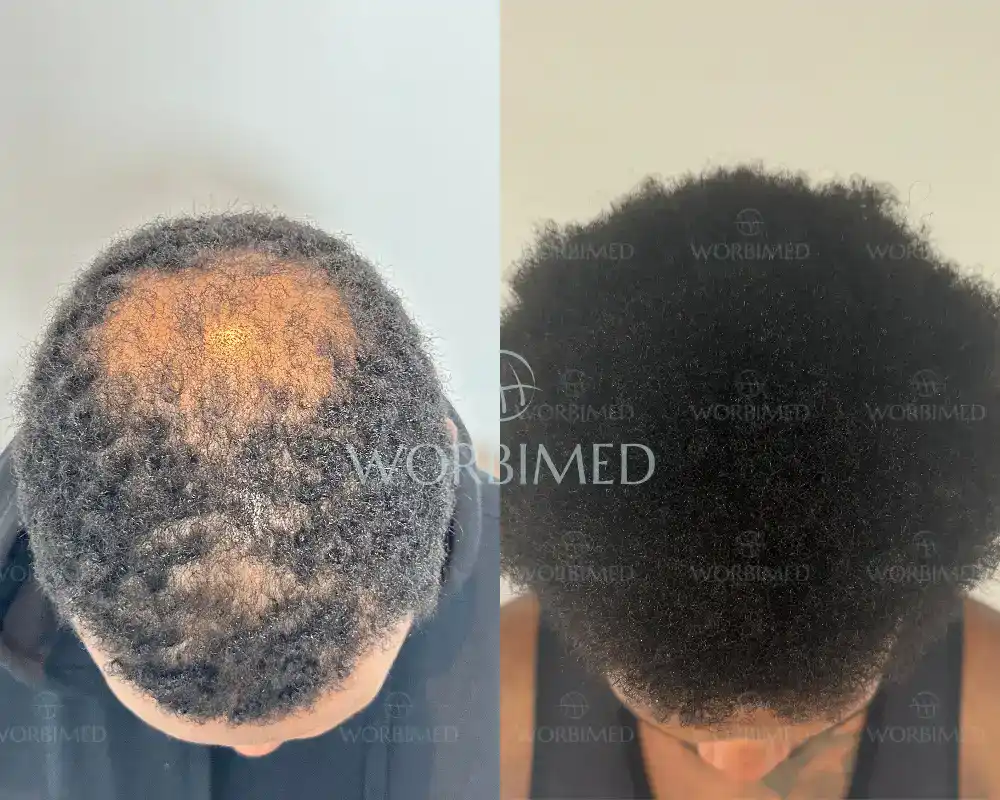
What this means for donor-area planning
Because curved follicles are more easily damaged during extraction, and because Afro hair donor density is naturally somewhat different from straight-haired donor areas, donor-area planning deserves more care than a quick estimate. A careful surgeon will assess:
- Existing donor density and hair calibre
- The degree of curl/curvature specifically in your donor zone
- How much can be safely extracted without thinning the donor area itself
- Whether your hair loss is likely to progress further, which affects how conservatively the donor area should be used now
A clinic that gives you a graft number and a price before properly examining your donor area (in person or through detailed photos/video) is skipping a step that genuinely affects your results.
Contents
FUE, DHI, or Sapphire FUE — which is right for afro hair?
You’ll see clinics claim that one of these is simply “the best” for Afro hair. That’s an oversimplification. Here’s what each term actually means, and what actually matters more than the label.
What FUE actually means
FUE (Follicular Unit Extraction) is a method of harvesting individual grafts one at a time from the donor area using a small punch, rather than removing a strip of scalp tissue.
For Afro hair, what matters most within “FUE” is the punch shape and the extraction motion — a curved or curl-adapted punch used with a controlled, often slower motion, versus a standard straight rotary punch used at speed.
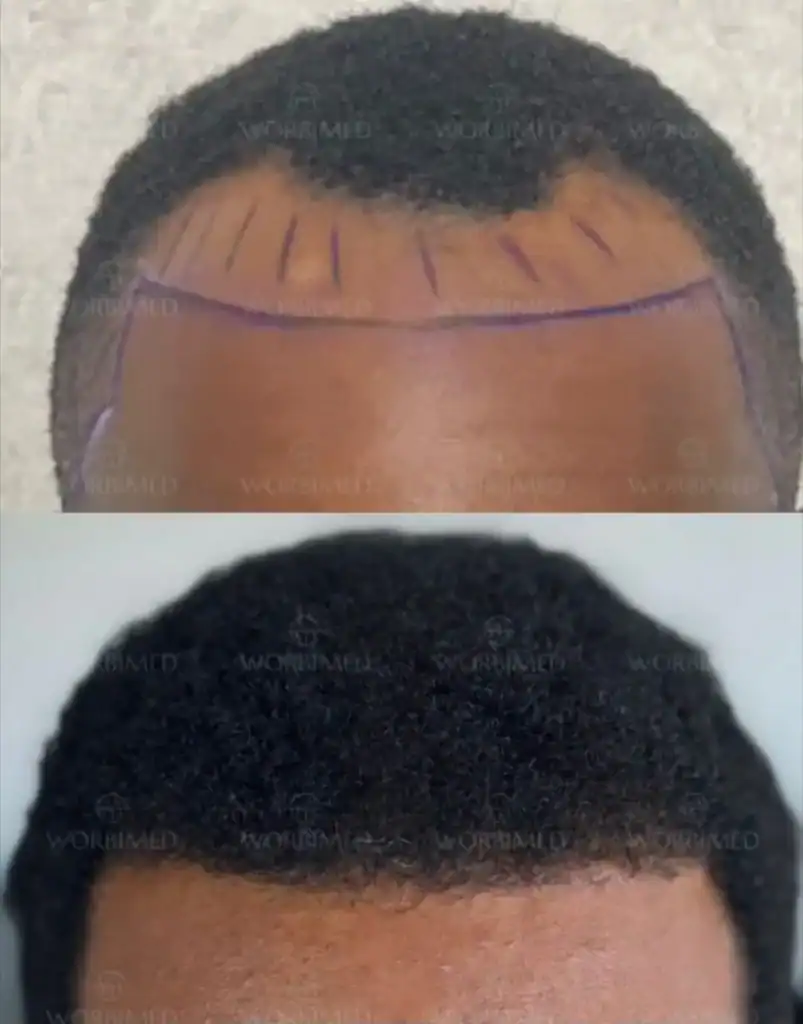
What DHI actually means
DHI (Direct Hair Implantation) is a variation on implantation, not extraction. Grafts are loaded into a pen-like device (often called a Choi pen) and implanted directly into the scalp without pre-making a separate recipient-site incision.
Advocates point to shorter time outside the body for the graft and fine control over depth and angle.
The extraction step for DHI still needs the same curl-aware approach described above. DHI doesn’t solve the extraction/transection challenge on its own — it’s a different implantation method.
What “Sapphire” refers to
“Sapphire FUE” refers to the material of the blade used to open recipient-site channels — sapphire blades rather than steel. The claimed benefit is a cleaner incision, which some surgeons believe supports denser packing and faster healing.
This is a channel-opening detail, not an extraction method — it doesn’t by itself address follicle curvature either.
Why surgeon experience — and the right tool for your curl pattern — matter more than the label
Whichever technique is used, the person extracting your grafts needs real, hands-on experience with curly and coily follicles, curl-adapted tools rather than standard straight punches, and extraction settings adjusted for your specific curl pattern rather than the settings used for straight hair.
Beyond that, though, we think the choice between DHI and FUE Sapphire specifically matters for Afro-textured hair — and it’s worth explaining why.
Why Worbimed recommends FUE Sapphire over DHI for Afro-textured hair
Here we’ll be direct about our own clinical position, and explain the reasoning rather than just asserting it.
DHI implantation relies on loading each graft into a Choi pen — a narrow, straight metal canal — before placing it into the scalp.
That canal is straight because it was designed around the way a straight or gently wavy follicle behaves. The graft slides in and out cleanly.
A curly or tightly coiled Afro-textured graft doesn’t have that shape. Based on our clinical experience and the cases our team has handled, loading a curved graft into a straight pen canal creates a real, mechanical risk: the graft can be compressed or bent to fit the canal, and that compression can damage or break the follicle before it’s even implanted.
This isn’t a criticism of DHI as a method in general. For straight and wavy hair, where the follicle shape matches the canal, it works well and offers real advantages in speed and placement control. The issue is specifically the mismatch between a straight implanter canal and a curved graft.
For this reason, our team’s preference for patients with curly to tightly coiled (Afro-textured) hair is FUE Sapphire — extracting grafts with a curl-adapted approach and placing them into pre-made sapphire-blade channels, rather than forcing them through a straight implanter pen.
We think this is a meaningful, practical distinction that’s often glossed over in marketing material that presents DHI as a universal upgrade regardless of hair type.
How we match technique to hair type, based on our clinical experience:
For straight and wavy hair, both techniques are viable, and the choice depends on your specific case. For curly and coily hair, we consistently favor FUE Sapphire, for the mechanical reason explained above.
| Hair type (Andre Walker classification) | Curl pattern | Technique we recommend | Why |
|---|---|---|---|
| Type 1 | Straight | DHI or FUE Sapphire — depends on the case | Follicle runs straight beneath the scalp, so it loads cleanly into a straight implanter canal; either technique works well, and the choice comes down to graft count, density goals, and the specifics of your case |
| Type 2A / 2B / 2C | Wavy | DHI or FUE Sapphire — depends on the case | Curl beneath the skin is mild enough that the graft still loads cleanly into a straight implanter canal; both techniques are viable, and we choose based on your individual plan |
| Type 3A / 3B / 3C | Curly | FUE Sapphire | Subsurface curvature increases; forcing the graft into a straight pen canal raises the risk of compression or breakage during loading |
| Type 4A / 4B / 4C (Afro-textured) | Coily / tightly coiled | FUE Sapphire | Follicle curves sharply beneath the scalp; a straight implanter canal is a poor mechanical match, so we extract and place these grafts without forcing them through a Choi pen |
This is our clinic’s clinical approach, based on our team’s experience. Other clinics may take a different view, including some who offer modified or curved implanter tools specifically for curly hair.
If you’re evaluating a clinic that recommends DHI for your specific hair type, it’s a fair question to ask what implanter tool they’re using and how they’ve adapted it for curl.
Afro hair transplant cost in Turkey (2026)
Afro hair transplant in Turkey typically costs $2,500 to $6,000, depending mainly on graft count, technique, and what’s included in the package.
Advertised prices vary considerably between clinics — this range reflects the broader market in 2026, not a single fixed rate, and some higher-end or larger-graft-count cases are quoted beyond it. Treat any single number you see, including this one, as a starting point rather than your actual quote.
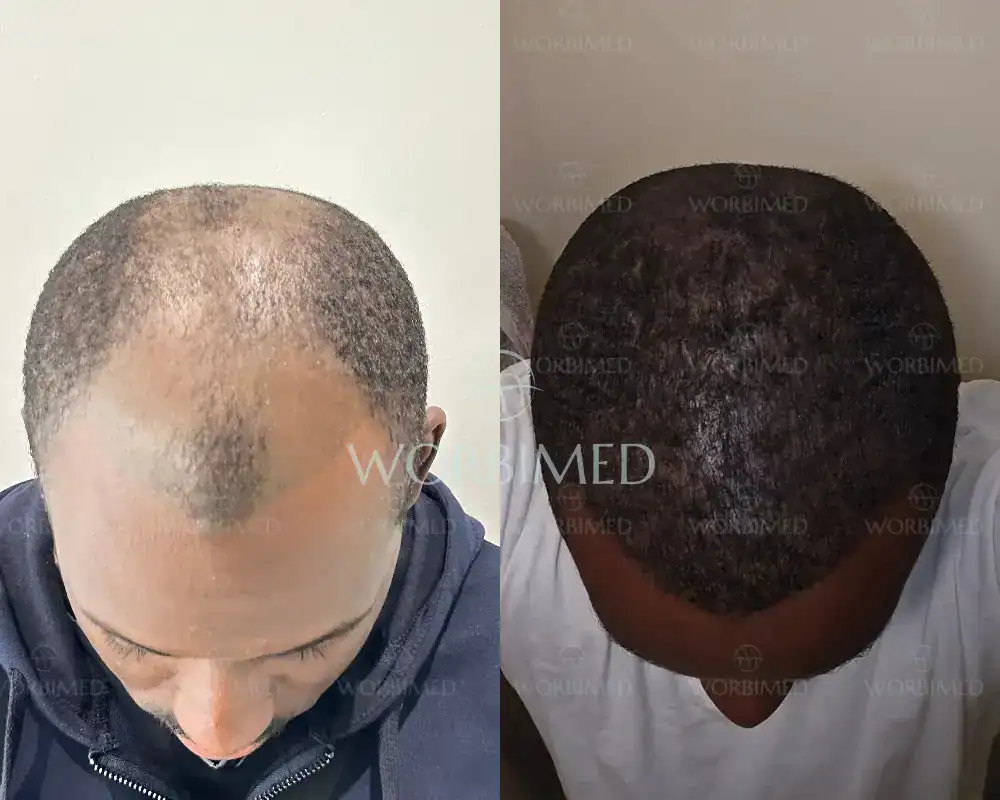
The main things that move the price:
| Factor | Why it affects cost |
|---|---|
| Graft count | More grafts generally means more surgical time and more surgeon/technician hours |
| Technique | Sapphire blades, DHI pens, and manual curl-adapted extraction all involve different tooling and time |
| Complexity of extraction | Tighter curl patterns and higher transection risk require slower, more careful work |
| Surgeon vs. technician involvement | Clinics where the lead doctor personally performs extraction and channel-opening, rather than delegating the whole procedure, often price differently than technician-run clinics |
| Package inclusions | Hotel, airport transfers, medication, translator support, aftercare kit |
| Number of treatment days | Multi-day protocols (consultation day, procedure day, wash/check day) vs. single-day |
| Optional add-ons | PRP therapy, VIP transport, extended aftercare |
What should be included in an all-inclusive package
Before comparing prices between clinics, check whether each quote actually includes the same things. A lower headline price with fewer inclusions can end up costing more once you add hotel nights, transfers, or medication separately. Ask specifically whether the quoted price includes:
- Airport pickup and drop-off
- Hotel accommodation, and for how many nights
- Post-operative medication
- Aftercare kit (shampoo, spray, etc.)
- Any translator/coordinator support during your stay
- Follow-up consultations after you return home
- Whether the price is per-graft or a fixed package regardless of final graft count
Turkey vs UK vs USA cost comparison
| Destination | Typical advertised range | Notes |
|---|---|---|
| Turkey | Roughly $2,500–$6,000+ (all-inclusive packages common) | Wide range depending on clinic tier, graft count, and technique; genuinely all-inclusive packages are common but should be verified item by item |
| United Kingdom | Roughly £5,000–£15,000+ | Rarely all-inclusive of travel/accommodation since patients are typically local; per-graft or per-session pricing common |
| United States | Roughly $10,000–$25,000+, sometimes higher | Often billed per graft; specialist surgeons with significant Afro-hair experience may price at the higher end |
These are broad, commonly advertised ranges rather than fixed figures — actual quotes depend on your specific case, the clinic, and the surgeon. Get a personal assessment before assuming any number applies to you.
A note on why Turkey is generally cheaper, honestly stated: lower prices don’t mean lower quality.
Turkey performs an exceptionally high volume of hair transplant procedures every year, which means many surgeons and clinics have built deep, repeated experience specifically with hair restoration — including Afro-textured hair. That scale, combined with intense competition between clinics and lower operating/staffing costs, explains why hair transplant cost in Turkey tends to be lower — not any shortcut on care.
If price were the only factor, there would be no reason for people who can easily afford treatment anywhere in the world to choose Turkey — yet Turkey has become a genuine destination of choice, not just a budget option, for people specifically seeking hair transplant expertise.
Well-known public figures, including singers and professional athletes, have travelled to Turkey specifically for hair transplant procedures. That’s a reasonable signal that clinics here are competing on skill and outcomes, not only on cost.
It’s also worth being clear-eyed in the other direction: inconsistent or poor-quality service exists in every country, not only in Turkey. A low price on its own tells you very little about quality — and so does a high price. The diligence outlined in the clinic-selection checklist later on this page matters regardless of which country you choose.
How many grafts do you actually need for an Afro hair transplant?
A graft is a small unit of skin containing one or more hair follicles — it is not the same thing as “one hair.”
A single graft in Afro-textured hair may contain a similar number of hairs as in straight hair. But because each curly/coily strand curves and covers more visual surface area as it grows, Afro hair can sometimes achieve a fuller appearance with a comparable or occasionally lower graft count than the same area would need with straight hair.
This isn’t a guaranteed rule for every patient — curl pattern, hair calibre, and donor density all affect it — but it’s a genuine reason to be skeptical of a clinic that quotes a very high graft number as if bigger is automatically better.
A few things worth understanding before you compare graft-count quotes between clinics:
- Donor supply is finite. You can’t “buy” more grafts than your donor area can safely provide. A clinic promising an unusually high graft count for a modest donor area should raise questions, not excitement.
- Aggressive extraction can create a second problem later. Overharvesting the donor zone can visibly thin it, which matters permanently since donor hair doesn’t regenerate once removed.
- Graft numbers should follow assessment, not precede it. A reliable estimate comes after your donor area, hair loss pattern, and goals have actually been evaluated — not from a generic price list.
As a general point of reference only (not a prescription for your case): many male hairline and temple cases are planned in a range of roughly 1,500–2,500 grafts, and many female traction-alopecia/edge cases fall in a lower range, often under 2,000 — but your actual plan should come from your own consultation, not from a table like this.
“Why can’t I just take 5,000 grafts from my donor area in one session?” — this is one of the most common questions we get from Afro patients, and it deserves a direct, honest answer rather than a promise.
For patients with straight hair and a very dense donor area, roughly 5,000–5,500 grafts is generally considered the safe upper limit that can be extracted in a single session without risking visible thinning of the donor zone.
But that figure comes from straight-hair donor anatomy, and it doesn’t transfer directly to Afro-textured donor areas.
Because Afro-textured follicles curve beneath the skin, the risk of damaging surrounding follicles and thinning the donor area during extraction is meaningfully higher than with straight hair, even in experienced hands.
As a result, the realistic safe maximum for a single session in Afro-textured donor areas is lower. In our clinical experience, even with very good donor density, that ceiling is typically around 4,000–4,500 grafts, and reaching that upper range isn’t common — it applies to a minority of patients with unusually strong donor supply.
Across our own cases, the largest single-session graft count our team has performed is 4,600 grafts.
If a clinic promises you 5,000–6,000 grafts in one session based on your Afro-textured hair, treat that as a warning sign rather than good news. A number that high, offered without a proper donor-area assessment first, usually means the quote is built to sound impressive rather than to protect your donor area long-term — and donor-area damage from overharvesting isn’t reversible.
Keloids and scarring after an Afro hair transplant — what the evidence actually says
This section matters, and it’s one most clinic pages avoid or oversimplify. We’re not going to do either.
Who is at higher risk, and why individual history matters
Keloids are raised scars that grow beyond the boundary of the original wound, caused by an overproduction of collagen during healing. According to the American Academy of Dermatology, they are more commonly reported in people with darker skin types (Fitzpatrick IV–VI), which includes many people of African, Afro-Caribbean, South Asian, and Hispanic descent.
General dermatology sources cite keloids affecting roughly a tenth of the population overall, with meaningfully higher rates in these groups.
That statistic describes a population tendency. It does not mean every person with Afro-textured hair or darker skin is at high individual risk.
The much stronger predictor is personal or family history: if you or a close family member has developed a keloid or a noticeably raised scar after a previous cut, piercing, or surgery, that’s the detail that should shape your risk conversation with a surgeon — far more than ethnicity alone. If you have no such history, your individual risk is meaningfully lower than the population statistic on its own would suggest.
True keloid formation after hair transplant specifically appears to be uncommon overall — commonly described in the clinical literature as affecting a small minority of patients — but it is not zero, and documented cases exist even after FUE, which uses much smaller wound sites than older strip (FUT) techniques.
FUE vs FUT and scarring
FUT (strip harvesting) leaves a single linear donor scar, which carries a higher risk of a visible or problematic scar in keloid-prone individuals because of the length and tension of that incision.
FUE creates many small, circular micro-wounds instead, which generally heal with far less visible scarring and lower risk — though “lower risk” is not “no risk.” For patients with a personal or family history of abnormal scarring, this is one of several reasons FUE (or DHI, which uses a similarly small extraction footprint) is usually the more cautious choice over FUT.
How risk is managed before and after surgery
A responsible clinic will:
- Ask directly about personal and family keloid/scarring history during consultation
- Consider a small test area first for patients with a known predisposition
- Favor lower-tension techniques and avoid unnecessarily large recipient incisions
- Recommend evidence-based aftercare (such as silicone-based scar care where appropriate) and early intervention — for example steroid-based treatment — if any thickening appears during healing
- Tell you plainly if they think your case needs a dermatologist’s input before proceeding, rather than proceeding regardless
If you have any personal or family history of keloids, raise it explicitly at your first consultation — don’t wait to be asked.
Afro hair transplant for men
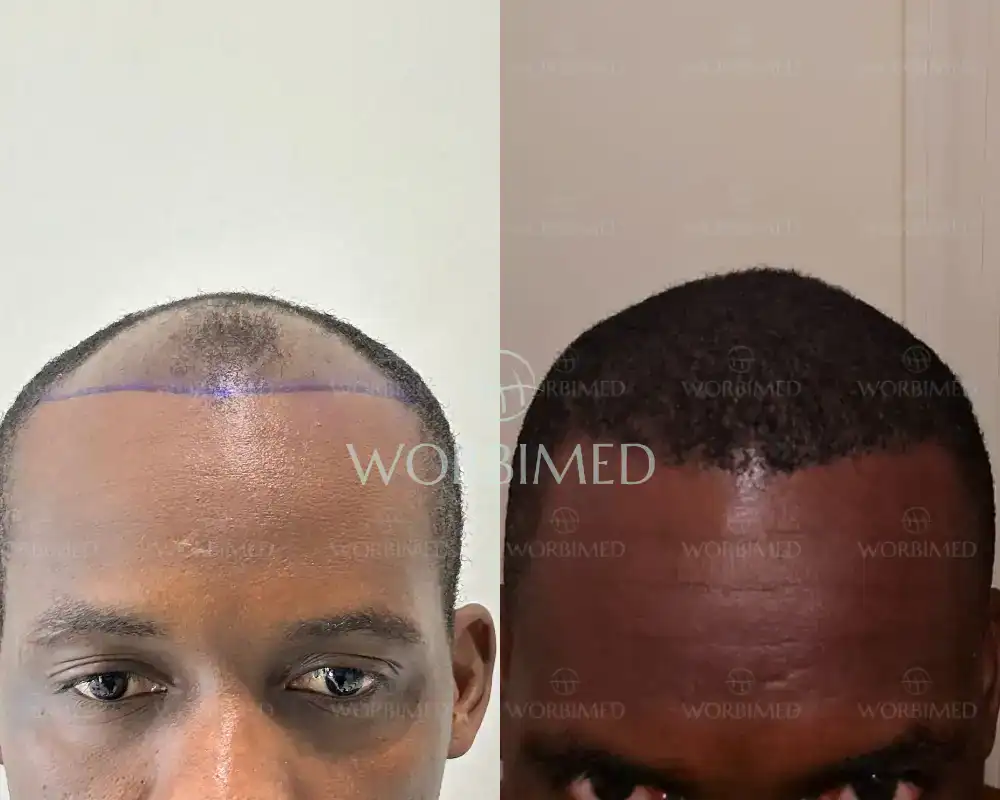
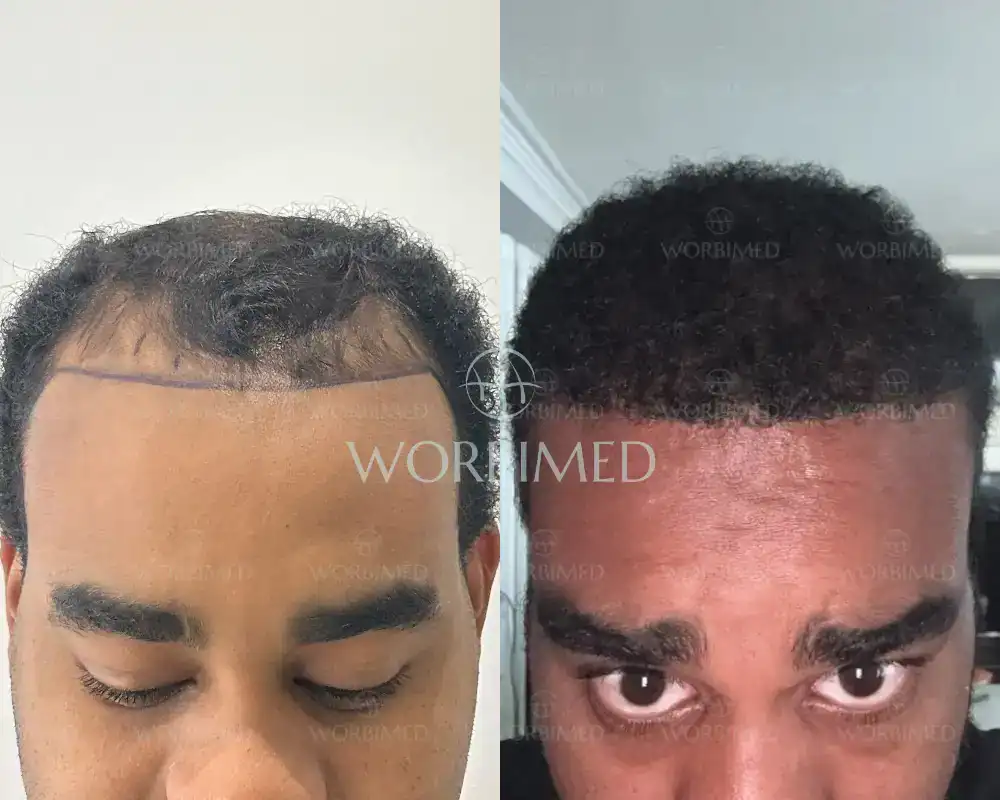
Common concerns we hear from male patients with Afro-textured hair include a receding hairline, temple recession, crown thinning, and isolated bald patches — the same general patterns of male pattern hair loss (androgenetic alopecia) seen across ethnicities, but requiring curl-aware extraction and implantation as described above.
Hairline design for Afro hair also has its own considerations: the natural hairline in many Afro-textured patients has a slightly different shape and density gradient than a straight-haired hairline. A hairline drawn without attention to this can look artificial even with technically sound grafts.
Afro hair transplant for women
Hair loss in women with Afro-textured hair often has different underlying causes than male pattern loss, and identifying the actual cause matters before anyone talks about grafts.
Traction alopecia — causes and candidacy
Traction alopecia is hair loss caused by chronic mechanical tension on the hair follicle — most commonly from tightly styled braids, weaves, cornrows, extensions, or tight ponytails worn repeatedly over time. It typically shows up first at the hairline and temples, where tension is often greatest.
It’s important not to overstate this: wearing braids or protective styles does not mean someone will develop traction alopecia.
Research published in dermatology literature has found meaningfully elevated prevalence among women and girls of African descent — figures in published studies range roughly from the high teens (in younger populations) to around a third of adult women in some surveyed groups. This shows the condition is common, not universal, and depends heavily on styling tension, frequency, and individual scalp sensitivity.
The distinction that actually matters for transplant candidacy is whether the affected follicles are still alive (early-stage, potentially recoverable with a change in styling and possibly medical treatment) or have been permanently destroyed (late-stage, where transplant becomes the realistic option). This is a clinical judgment, not something to self-diagnose.
CCCA and other scarring alopecias — why these need medical assessment first
Central centrifugal cicatricial alopecia (CCCA) is a separate, progressive scarring condition that typically begins at the crown and spreads outward. It needs to be inactive (confirmed by clinical assessment, sometimes including a scalp biopsy) before transplantation is appropriate — transplanting into active, inflamed tissue generally fails and can make things worse.
If your hair loss pattern looks unusual, doesn’t clearly match typical traction-alopecia or pattern-loss presentation, or has been progressing steadily, ask specifically whether CCCA or another scarring alopecia should be ruled out before any transplant planning continues.
Edge and hairline restoration
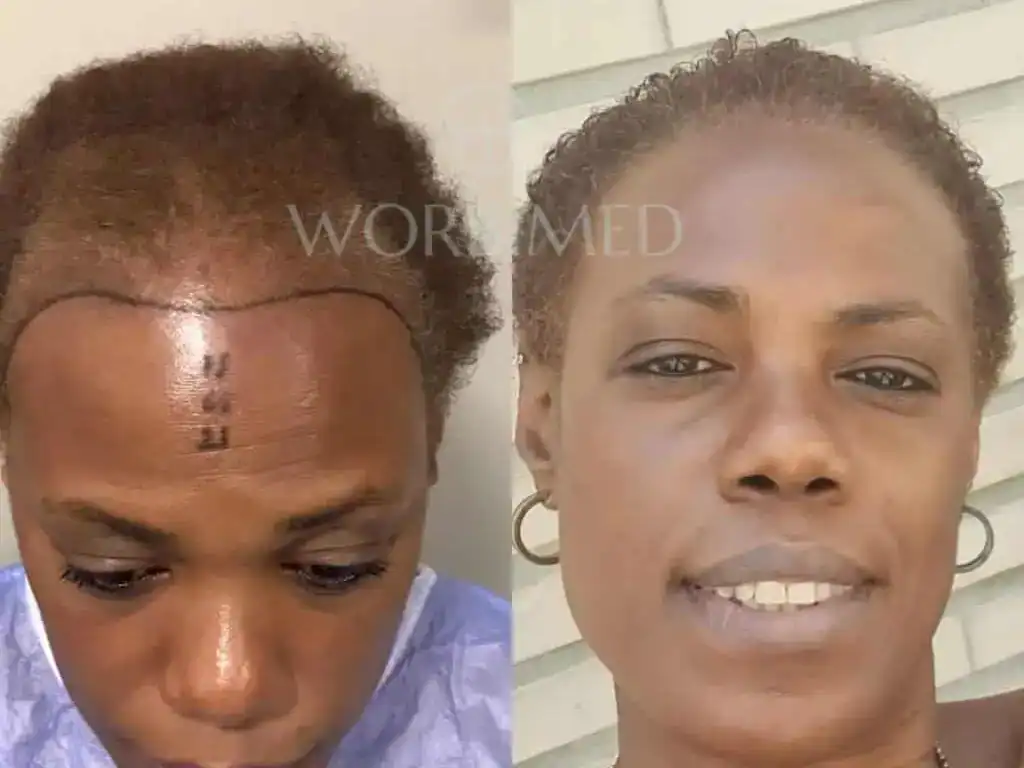
Once the underlying cause is properly identified and stabilized, edge and hairline restoration for women focuses on soft, natural density along the frontal hairline and temples, matching the surrounding curl pattern and respecting future styling needs — since donor hair, once used, is a limited resource.
Read more on hair transplant for Black women →
Afro hair transplant recovery and growth timeline
Every patient heals at a different pace, and this timeline is a general guide, not a guarantee.
| Period | What’s typically happening |
|---|---|
| Day 1 | Mild swelling, redness, and tenderness in both donor and recipient areas |
| First week | Scabs form over grafts; sleeping at an incline and avoiding direct scalp contact usually recommended |
| Weeks 2–4 | Scabs shed; some transplanted hairs fall out (“shock loss”) — this is expected and does not mean the graft has failed, since the follicle itself typically remains intact beneath the skin |
| Months 2–3 | A resting phase for many follicles; visible growth is often minimal or not yet noticeable |
| Months 3–4 | Fine, early new hairs commonly begin to appear |
| Months 5–6 | Growth usually becomes more noticeable; hair often still looks thin or patchy in places |
| Months 7–9 | Density typically continues increasing; texture and curl pattern gradually mature |
| Months 10–12 | Most patients see the majority of their result by this point |
| Beyond 12 months | Further thickening and curl maturation can continue for some patients, sometimes up to 18 months |
Shock loss deserves a specific note: it can range widely between patients — from barely noticeable to a large proportion of transplanted hairs temporarily shedding — and neither end of that range reliably predicts your final result. It is a normal part of the follicle’s growth cycle, not a sign of a failed procedure.
General aftercare through this period usually includes avoiding direct sun exposure and strenuous exercise for a period specified by your surgeon, following specific washing instructions in the first weeks, and — for Afro-textured hair specifically — avoiding tight styling, braiding, or heavy tension on both the donor and recipient areas for several months to protect healing grafts.
Afro hair transplant risks and possible complications
No hair transplant is risk-free, and a page built around trust shouldn’t pretend otherwise. Along with the keloid/scarring risk discussed above, general risks and possible complications include:
- Infection at donor or recipient sites
- Bleeding or excessive swelling
- Temporary numbness around treated areas
- Pain or discomfort during recovery
- Poor or uneven graft growth
- Graft transection during extraction (higher risk in Afro hair without curl-adapted technique, as discussed above)
- An unnatural-looking hairline if design or angling is done poorly
- Overharvesting of the donor area
- Visible scarring
- Folliculitis (inflammation around healing follicles)
- Shock loss affecting existing native hair near the treated area
- The need for a touch-up or revision procedure in some cases
Choosing an experienced surgical team and being properly screened as a candidate can reduce these risks meaningfully — but no clinic can honestly promise to eliminate them entirely. Be cautious of any page that implies otherwise.
Who is a good candidate for an Afro hair transplant?
A proper candidacy assessment looks at several things together, not any single factor in isolation:
- The underlying cause of your hair loss (pattern loss, traction alopecia, CCCA, or another cause)
- Whether that hair loss is currently stable or still actively progressing
- The condition and density of your donor area
- Your age and expected future hair-loss progression
- Overall scalp health
- Any personal or family history of keloids or abnormal scarring
- Any previous hair transplant history
- Realistic expectations about what a transplant can and can’t achieve
We’re not going to attempt to diagnose your specific situation on a web page — that’s exactly what a proper consultation is for, ideally with clear photos or video of your donor area and the affected zones.
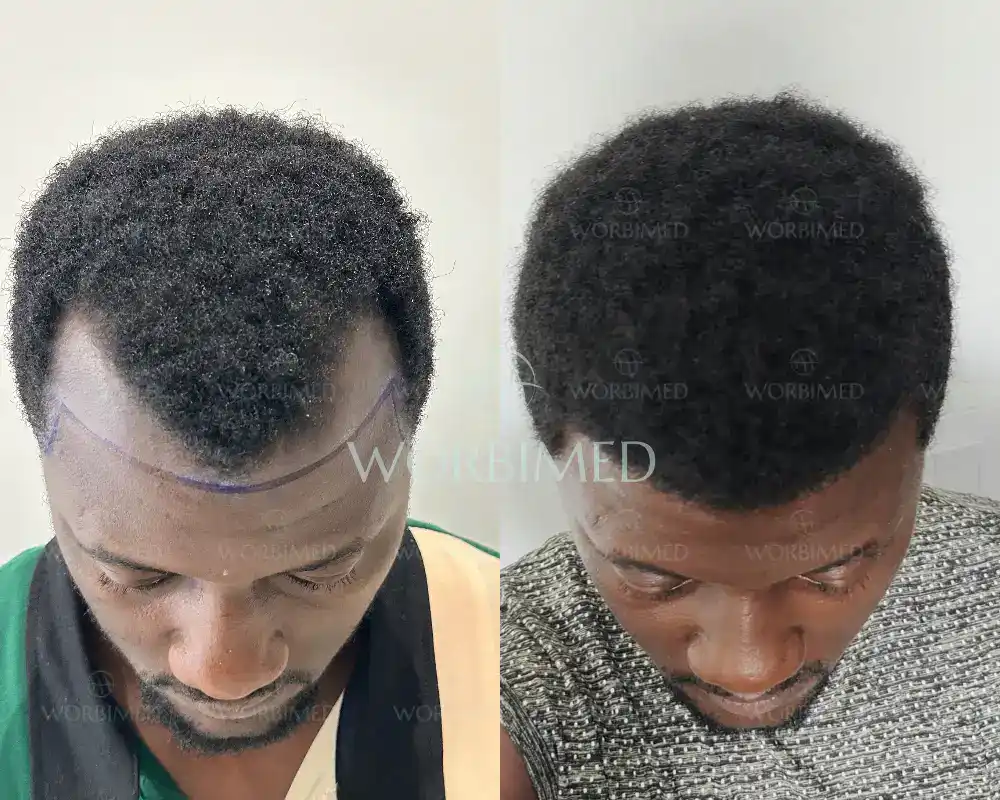
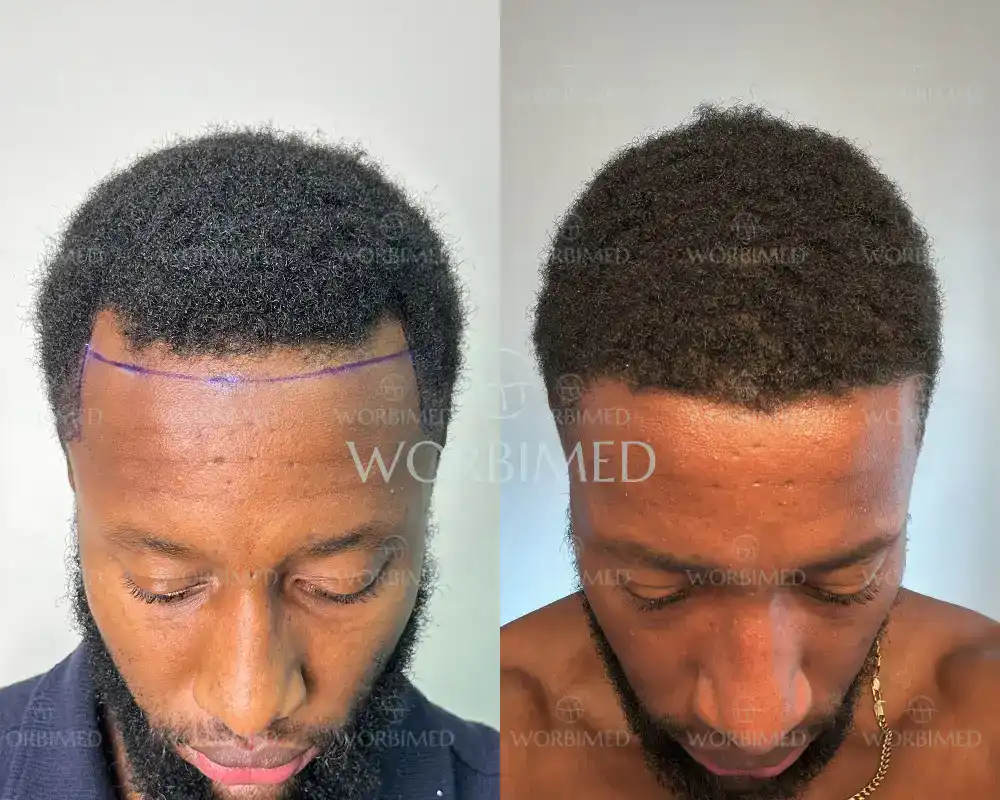
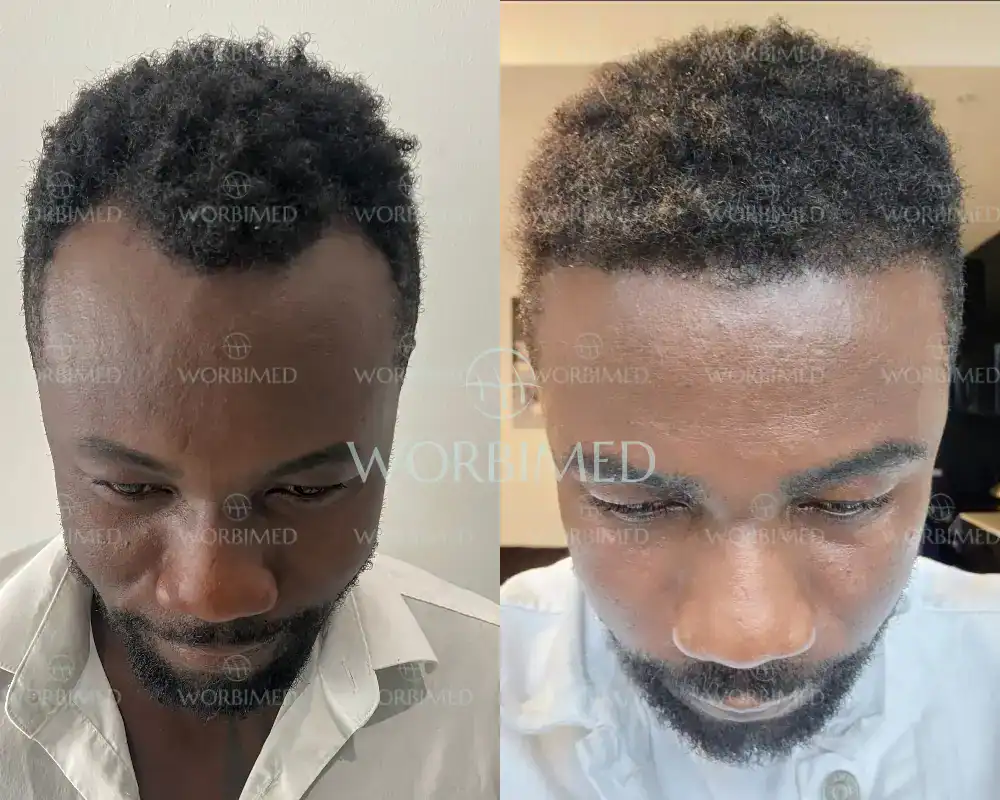
Afro hair transplant before and after — how to actually judge results
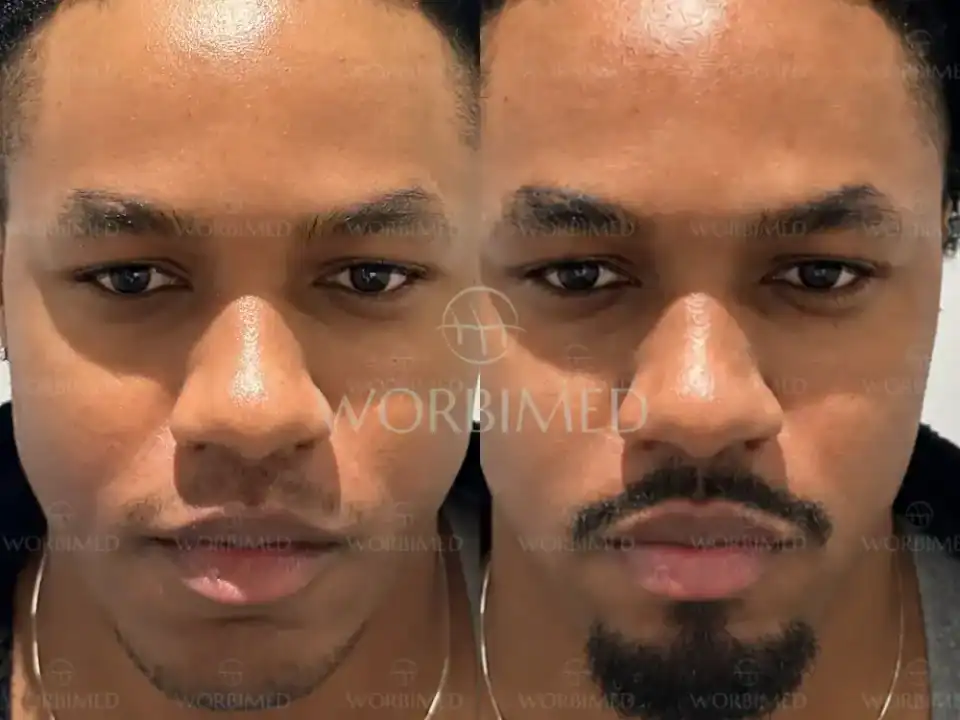
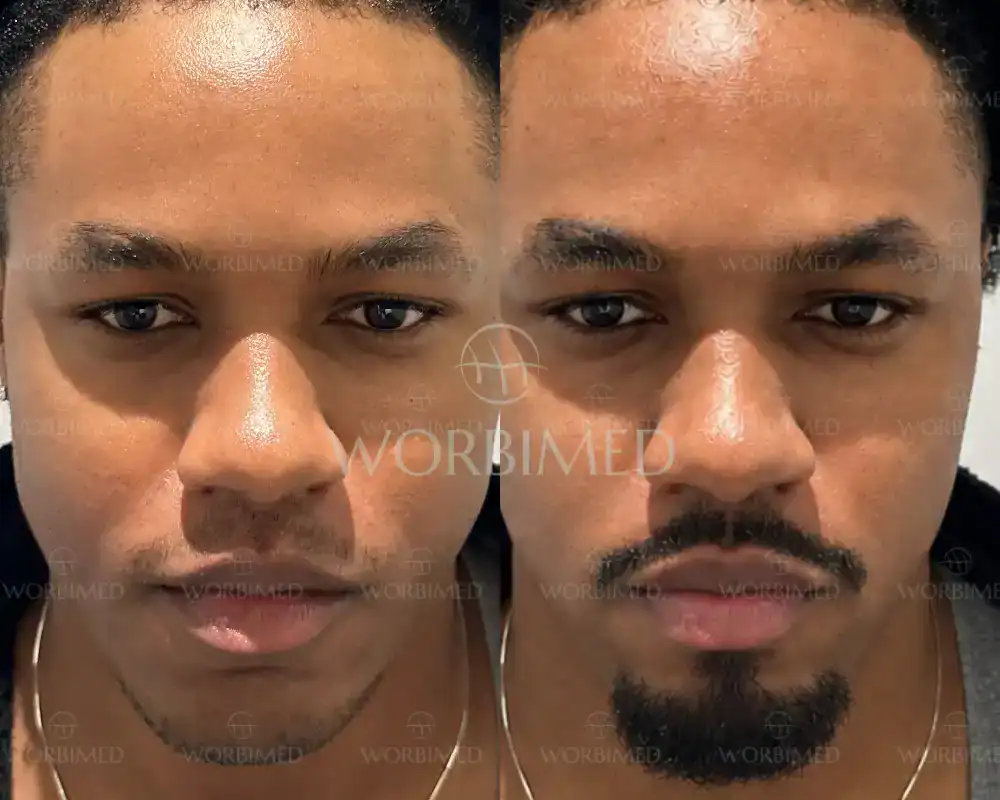
Photos are the most persuasive thing on any hair transplant page — which is exactly why they’re worth looking at critically, including ours. Below, we’ve laid out what actually separates a meaningful before-and-after comparison from one that’s just flattering lighting and a good angle.
What to look for
When you’re evaluating anyone’s before-and-after photos — ours or a competitor’s — look at:
- Hairline design — does it follow a natural, slightly irregular line rather than a stiff geometric one?
- Density — is coverage even, or are there patchy or thin transition zones?
- Direction and curl integration — does the transplanted hair’s growth direction and curl pattern match the surrounding native hair?
- Donor-area appearance — does the donor zone still look natural, or visibly thinned?
- Scarring — is there visible scarring in either the donor or recipient area under normal lighting?
- The transition zone — does the hairline blend into the rest of the scalp, or is there a visible line?
- Timeline stated — is the “after” photo taken at a point where growth has actually matured (generally 10–12+ months), or earlier, when results are naturally still incomplete?
Why some before/after photos are misleading
Photo comparisons can look far more dramatic — or far less honest — than the actual result, depending on a few easily manipulated factors:
- Different lighting between the two photos (harsh side lighting can hide thinning; soft even lighting can flatter density)
- Hair styled differently — combed forward vs. back, product used to add apparent volume
- Different hair length between “before” and “after,” which changes perceived density on its own
- A different camera angle or distance
- One photo wet, one dry — wet hair clumps and can look thinner or, styled carefully, thicker
- Other treatments (PRP, medication, styling products) applied between photos without disclosure
A trustworthy clinic will be transparent about the timeframe and conditions under which their photos were taken, rather than letting you assume.
Turkey vs UK vs USA — the full picture
Beyond the price comparison earlier on this page, a few other factors are worth weighing honestly:
| Factor | Turkey | UK | USA |
|---|---|---|---|
| Typical cost | Lower, often all-inclusive | Higher, usually excludes travel since typically local | Highest, often per-graft billing |
| Travel required | Yes, for most international patients | Not usually needed if local | Not usually needed if local |
| Surgeon access for Afro hair specifically | Growing pool of specialists; verify individual experience, don’t assume by clinic size | Fewer dedicated specialists; more limited choice in some regions | Several well-regarded specialist surgeons, at higher cost |
| Aftercare/follow-up | Often remote after you return home — confirm exactly how this works | Easier in-person follow-up if local | Easier in-person follow-up if local |
| Regulation | Ministry of Health licensing exists, but clinic quality still varies significantly — verify individually | Established regulatory framework, but still verify individual surgeon/clinic credentials | Established regulatory framework, but still verify individual surgeon/clinic credentials |
| Total trip cost | Add flights, and any additional nights beyond the package if needed | N/A for local patients | N/A for local patients |
People choose Turkey mainly for cost and package convenience — but that doesn’t make every Turkish clinic automatically comparable, and it doesn’t make Turkey automatically “better” than a well-chosen UK or US surgeon for every patient. What you should verify before booking anywhere is the same regardless of country: who specifically performs your surgery, what their experience with Afro-textured hair actually is, and what happens if you need follow-up after you’ve gone home.
How to choose a clinic for afro-textured hair
This is arguably the most useful section on this page. Before committing to any clinic — including ours — ask:
| Question | Why it matters |
|---|---|
| Who performs the extraction and channel-opening steps? | These are the most technically demanding parts of the procedure for Afro-textured hair |
| Who performs implantation? | Worth knowing whether this is done by the doctor or by trained technicians, and being told clearly either way |
| How much specific experience does the team have with Afro-textured hair (not hair transplant in general)? | General FUE experience doesn’t automatically transfer to curl-adapted extraction |
| Can they show genuine cases of their own Afro-textured patients? | Stock or borrowed images are unfortunately common in this industry |
| Are before/after photos taken under consistent, disclosed conditions? | See the section above |
| What happens if growth is below expectations? | A clinic without a clear answer here is avoiding accountability |
| What exactly is included in the quoted price? | See the cost section above |
| Who provides follow-up after you return home, and how? | Especially important for international patients |
| What happens if there’s a complication after you’ve left the country? | A responsible clinic should have a real answer, not just reassurance |
| Is the clinic/facility properly licensed? | Verifiable, not just claimed |
A clinic confident in its own work should be able to answer every one of these directly and specifically, without redirecting the conversation back to price.
What clinics often don’t tell you
A few things worth knowing that don’t always make it into a sales conversation:
- A high graft number is not automatically a better outcome. It’s only meaningful relative to your donor supply and your actual coverage needs.
- Curl-adapted extraction technique matters more than the FUE/DHI/Sapphire label on the price list. Ask about the tools and technique, not just the acronym.
- Donor-area management is a long-term decision, not just a same-day one — overharvesting now can limit future options if hair loss progresses.
- A history of keloids or abnormal scarring matters more than ethnicity alone in assessing your personal risk — this should be an explicit part of your consultation.
- A lower headline price isn’t necessarily the cheaper final option once you compare inclusions item by item against a higher quote.
- Before-and-after photos need consistent lighting, styling, and a disclosed timeframe to mean anything — ask, don’t assume.
- A hair transplant does not stop future native hair loss in untreated areas of your scalp. If your pattern loss is still progressing, you may want (or need) a long-term management plan alongside — not instead of — surgery.
- Very precise, uncited statistics (a specific survival percentage down to a decimal point, for example) should be treated with some skepticism unless the clinic can show where the number actually comes from. Real clinical evidence in this field is often expressed as a range, not a single decimal-point figure.
We’d rather you know these things before you book with anyone — us included.
Why patients choose Worbimed for afro hair transplant
We’re not going to claim to be “the best” or “number one” clinic in Turkey — that’s not a claim we could actually back up, and we don’t think it’s a useful thing to tell you anyway.
What we can tell you specifically: Worbimed is one of the clinics in Istanbul that focuses specifically on Afro-textured hair, rather than treating it as a variation on a standard protocol. Our lead doctor has more than ten years of experience.
This is a deliberate structural choice in how we run procedures: the doctor personally performs the two most technically demanding steps — extraction of the grafts and opening the recipient channels. Implantation is carried out by trained technicians working under the doctor’s direction.
We structure it this way because, as explained earlier on this page, extraction and channel creation are the steps where curl-aware technique matters most for avoiding transection and achieving a natural result.
If you’d like an individual assessment of your case — including your donor area, hair loss pattern, and a realistic graft estimate — send us your photos and we’ll walk you through it honestly, including telling you if we don’t think you’re a good candidate yet.
Frequently asked questions
Is Afro-textured hair harder to transplant than straight hair?
Technically, yes — the follicles curve beneath the skin, which raises the risk of damage during extraction if the surgeon uses tools and technique designed for straight hair. With curl-adapted punches and an experienced team, this challenge is well understood and manageable.
How much does an Afro hair transplant cost in Turkey in 2026?
Afro hair transplant in Turkey typically costs $2,500 to $6,000, depending on graft count, technique, and what’s included in the package. Get an individual quote rather than assuming any single figure applies to your case.
Why do quoted prices vary so much between clinics?
Mainly graft count, technique, whether the lead surgeon personally performs extraction, and what the package includes (accommodation, transfers, medication, follow-up). Two quotes that look similar on the surface can cover very different things.
Is FUE or DHI better for Afro hair?
At Worbimed, we generally recommend FUE Sapphire over DHI for curly to tightly coiled (Afro-textured) hair. DHI implants grafts through a straight Choi pen canal, and in our clinical experience, forcing a curved graft into that straight canal raises the risk of compression or breakage during loading. DHI still works well for straight to wavy hair, where the graft shape matches the canal. Other clinics may take a different approach — ask what implanter tool they use and how it’s adapted for curl if a clinic recommends DHI for your hair type.
How many grafts will I need?
It depends on your hair loss pattern, donor density, and goals — there’s no fixed number that applies to everyone. Afro hair’s curl can sometimes provide fuller visual coverage per graft than straight hair, but this varies by individual.
Am I at higher risk of keloids because I have Afro hair?
Darker skin types are statistically associated with higher keloid rates in the general population, but your individual risk depends far more on your personal and family scarring history. Tell your surgeon about any past keloid or raised-scar experience during consultation.
Is the procedure painful?
The area is numbed with local anesthesia before extraction and implantation, so the procedure itself is typically not painful. Some soreness, tightness, or mild discomfort during the following days is common.
How long does the surgery take?
Most sessions take roughly 6–10 hours, depending on the number of grafts and the complexity of extraction. Afro-textured hair can take longer than straight hair because of the extra care required during extraction.
When will I see results, and when are results final?
Early growth often begins around months 3–4, with more visible density by months 5–9. Most patients see close to their final result by 12 months, though some continue to see gradual improvement up to about 18 months.
Will transplanted hair stop future hair loss in the rest of my scalp?
No. A transplant restores hair in the treated area but doesn’t prevent ongoing pattern hair loss elsewhere on your scalp. If your hair loss is still progressing, ask your surgeon about a longer-term management plan.
Can traction alopecia be treated with a hair transplant?
Yes, if the affected follicles have been permanently damaged and the cause (tight styling) has stopped. If damage is still early-stage, a change in styling — sometimes alongside medical treatment — may help before surgery is needed. This distinction should be assessed clinically, not guessed at.
What’s the difference between having this done in Turkey vs. the UK or US?
Mainly cost and travel: Turkey is typically less expensive and often bundles travel logistics into the package, but it requires travel and usually remote follow-up once you’re home. UK and US options are typically more expensive but may offer easier in-person follow-up if you live locally.
What should I ask a clinic before booking?
Who performs extraction and channel-opening, how much specific Afro-hair experience they have, what’s included in the price, what their policy is if growth is poor, and how follow-up works after you return home. See the full checklist above.
Medically reviewed by the Worbimed clinical team · Last updated: 18.08.2026